

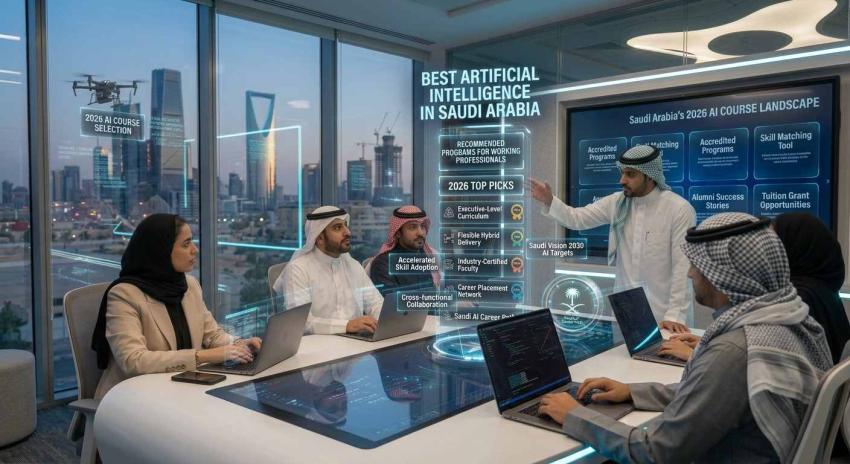
The best artificial intelligence course in Saudi Arabia isn’t the one with the most impressive marketing. It’s the one that ties directly to a professional’s actual job function, backed by real practice rather than theory. With 2026 declared the Kingdom’s Year of Artificial Intelligence, more providers than ever are competing for attention, making that distinction harder to spot but more important than ever.
Key Takeaways:
1. Function-specific AI courses outperform generic literacy workshops in real outcomes.
2. SDAIA targets 20,000 trained AI specialists by 2030, up from 11,000 today.
3. A 663,000-worker skills gap is driving urgent corporate training demand nationally.
4. Generative AI training now stands apart from general AI literacy programs.
Why Does Course Selection Matter More in 2026 Than Before?
Saudi Arabia’s Cabinet named 2026 the Year of Artificial Intelligence, triggering funding commitments and curriculum mandates across schools and government training programs. That national push means more training providers have entered the market, and quality now varies significantly between them.
Professionals evaluating an artificial intelligence course in Saudi Arabia today face far more options than two years ago, which makes course structure and outcomes matter more than provider size or marketing reach.
What Separates a Strong AI Course From a Weak One?
Depth versus breadth is the clearest signal. A national workforce survey found 84 percent of Saudi public servants received AI training, yet half described it as a box-ticking exercise rather than genuine skill development. Fifty-two percent said the training arrived too late to be useful.
Strong courses avoid this by building a real project into the curriculum, whether that’s a predictive model, an automation workflow, or a generative AI application tied to the learner’s actual role.
How Serious Is Saudi Arabia’s AI Skills Shortage?
Labor market data cited by Arab News projects a 663,000-worker skills gap by 2030, with an estimated $206.77 billion in unrealized revenue attached. Technology roles specifically show close to a 20 percent gap between open positions and qualified local candidates.
SDAIA’s own response includes training over 11,000 AI specialists as of early 2026, working toward 20,000 by 2030. That leaves substantial room for corporate training providers to fill the remaining demand.
How Much Does the Right Course Actually Cost?
Price ranges vary widely across the market, and cheaper isn’t automatically worse, but it correlates with the box-ticking pattern seen in national survey data. A course priced far below the market average for a multi-week applied program is usually a literacy session in disguise.
The more reliable way to evaluate cost is against outcome, not against other course prices. A slightly more expensive program that ends with a working model or automated workflow delivers more value than a cheaper one that ends with a certificate and nothing else.
Should Professionals Choose General AI Training or Generative AI Specifically?
The distinction has grown sharper. SDAIA’s December 2024 partnership with NVIDIA formalized generative AI as a separate national training priority, distinct from broader AI literacy programs. Generative AI skills, like building prompt-based workflows, tend to produce faster, visible results than conceptual AI training.
Someone who completes a strong generative AI course can typically apply it within the same working week, automating reporting, content, or analysis tasks immediately.
What to Check Before Enrolling
· Does the course build toward a real project, not just a certificate?
· Is content split by role, rather than one generic session for everyone?
· Can the provider deliver consistently across Riyadh, Jeddah, and Dammam?
· Does the curriculum distinguish generative AI from general AI literacy?
Is Location a Factor When Choosing an AI Training Provider?
Yes, particularly for companies with staff spread across multiple Saudi cities. Riyadh and Jeddah have the deepest pool of training providers, but demand is growing in Dammam and the Eastern Province as industrial and energy employers expand their own AI adoption.
Providers offering artificial intelligence training courses across Riyadh, Jeddah, Dammam, Makkah, and Madinah give companies consistency without forcing staff to travel or rely on inconsistent remote-only delivery.
How Long Should a Good AI Course Actually Take?
Duration is a useful filter on its own. Sessions lasting a single day or two are almost always literacy-level, useful for awareness but not for building applied skill. The public sector data on shallow training reflects exactly this pattern, since most short sessions end without a practical output.
Programs running four to twelve weeks tend to include enough time for a real project component, whether that’s a machine learning model, an automation workflow, or a generative AI application. Professionals comparing options should treat course length as a rough proxy for depth, then verify it by asking what participants actually built by the end.
Format matters too. In-person sessions in Riyadh or Jeddah suit teams that benefit from hands-on lab work, while hybrid or remote options serve staff in smaller cities or those balancing training around existing workloads.
Does University-Level AI Education Affect the Corporate Training Market?
Significantly. With 86 percent of Saudi universities now offering undergraduate AI degrees, new graduates enter the workforce with baseline AI knowledge that many current employees lack. This raises the bar for corporate training, since a generic literacy session no longer competes with what fresh graduates already know.
Companies now need applied, advanced training just to keep tenured staff competitive with incoming talent, not just to introduce AI concepts for the first time.
Is It Worth Comparing Multiple Providers Before Enrolling?
Yes, and most professionals skip this step. Requesting a sample lesson or a breakdown of the final project from two or three providers before committing reveals differences that marketing pages rarely show clearly.
Providers confident in their outcomes are usually willing to share specifics: what participants built, how long the applied portion runs, and how content differs across roles. Hesitation to answer these questions directly is often a more reliable warning sign than any price comparison.
Choosing the Right Artificial Intelligence Course in Saudi Arabia
The best artificial intelligence course in Saudi Arabia in 2026 is defined by structure, not scale. Programs built around real job functions, generative AI distinctions, and consistent multi-city delivery are outperforming generic sessions, and professionals who choose carefully now will be ahead of the curve as the Kingdom moves toward its 2030 AI specialist targets.
FAQs
What is the best type of AI course to choose in Saudi Arabia?
Courses built around a specific job function with a real project component outperform generic literacy sessions.
How many AI specialists is SDAIA targeting by 2030?
SDAIA aims to train 20,000 AI specialists by 2030, up from over 11,000 trained today.
Is generative AI training different from general AI courses?
Yes, generative AI focuses on practical tools like prompt workflows, treated as a distinct national priority since 2024.
Why do some AI courses fail to build real skills?
Many stay conceptual instead of including hands-on projects tied to a learner’s actual job.
Which Saudi cities have the most AI training options?
Riyadh and Jeddah lead, with growing provider options in Dammam and the Eastern Province.
How large is Saudi Arabia’s AI skills gap?
Research projects a 663,000-worker shortfall by 2030, tied to roughly $206.77 billion in unrealized revenue.