

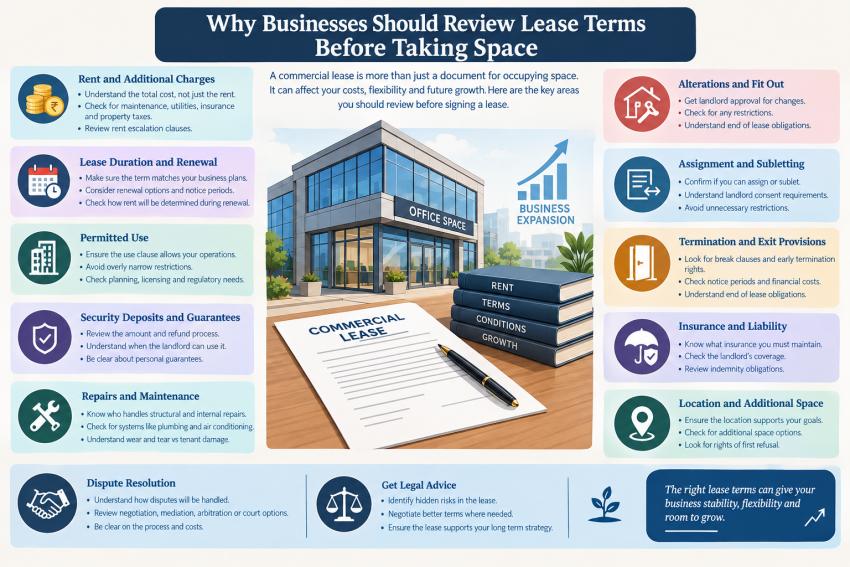
A well drafted commercial lease can support a business for years, while an unsuitable agreement can create financial and operational problems from the beginning. Before taking commercial space, businesses should look beyond rent and location and examine the full legal and commercial terms of the lease. An office, shop, warehouse, factory or other commercial property can influence operating costs, customer access, employee convenience and future growth. The lease governing the property establishes the rights and responsibilities of both landlord and tenant and may cover rent, security deposits, repairs, permitted use, renewal, termination, insurance, alterations and dispute resolution. Businesses should therefore review these provisions carefully before taking possession of commercial space.
Rent Is Only One Part of the Cost
Businesses often focus on monthly rent when comparing commercial properties, but rent may not represent the full financial commitment. A lease can require the tenant to pay additional amounts for maintenance, utilities, insurance, property taxes, common area expenses or other services, depending on the arrangement. Businesses should understand precisely what they will be required to pay throughout the lease period and check whether rent can increase during the term. A property with lower initial rent may not necessarily be more economical if additional charges are substantial or future increases are difficult to predict. Understanding the complete cost structure allows a business to prepare a more realistic property budget.
Lease Duration Should Match Business Plans
The length of a commercial lease can directly affect a company's flexibility and future planning. A long term lease can provide stability and allow a business to establish itself at a particular location without frequent relocation, which may be useful for retailers and businesses investing heavily in fitting out their premises. However, a long commitment can create difficulties if the business outgrows the space, changes its operating model or needs to relocate. A shorter lease may offer greater flexibility but can create uncertainty over future occupancy and rental costs. Businesses should therefore consider expected growth and foreseeable changes before agreeing to the lease period.
Permitted Use Can Affect Business Operations
Commercial properties are generally intended for particular activities, and lease documents often contain a permitted use clause defining how the tenant can use the premises. This provision deserves careful attention because a business may initially operate as an office but later require customer facilities, storage areas or additional operational activities. If these activities fall outside the permitted use, the tenant may need the landlord's consent before proceeding. Businesses should avoid agreeing to a description of permitted use which is unnecessarily narrow and should seek reasonable flexibility for legitimate changes in operations. They should also check whether the intended use complies with applicable planning, licensing and regulatory requirements.
Security Deposits and Guarantees Need Careful Review
Commercial leases commonly require security from the tenant through a security deposit, bank guarantee or personal or corporate guarantee. Businesses should understand the amount required, how the security will be held and the circumstances in which the landlord can use it. The lease should also explain how and when the security will be returned after the agreement ends. Personal guarantees deserve particular attention because a business owner may assume the company's liability is separate from personal obligations, while the lease may create additional responsibility. These provisions should be fully understood before the agreement is signed so the business can assess its financial exposure.
Repairs and Maintenance Can Create Unexpected Liabilities
Responsibility for maintaining commercial premises should be clearly established in the lease. An agreement may require the landlord to handle structural repairs while placing responsibility for internal maintenance on the tenant, while other arrangements may impose wider obligations on the tenant. Businesses should examine provisions concerning plumbing, electrical systems, air conditioning, fixtures, common areas and structural elements. It is also important to determine who will pay for repairs resulting from ordinary wear and tear compared with damage caused by the tenant. A clear allocation of maintenance responsibilities can reduce disagreements and unexpected expenses during the tenancy.
Alterations May Be Necessary as the Business Grows
Businesses often need to modify commercial premises as their operations develop, including installing partitions, equipment, signage, security systems or specialised facilities. A lease may require the landlord's prior consent before alterations are made, while some agreements may impose restrictions on the type or extent of permitted changes. Businesses should therefore understand the approval process and identify relevant limitations before committing to the property. This is particularly important for businesses whose operations depend on specialised premises because a property may appear suitable initially but become less practical if the tenant cannot make necessary changes as its requirements evolve.
Renewal Rights Can Provide Greater Certainty
Businesses investing in a particular location may want to remain there beyond the initial lease period, making renewal rights an important consideration. A renewal option can provide greater certainty, but the process may be subject to conditions such as notice periods, rent revisions or compliance with the existing lease. Businesses should check when notice must be given and how any revised rent will be determined. Missing a contractual deadline can sometimes result in the loss of a renewal opportunity, so important dates should be recorded and monitored well in advance. Renewal terms should also be considered alongside the company's future property requirements.
Assignment and Subletting Can Preserve Flexibility
Business circumstances can change during a lease, and a company may merge with another business, restructure its operations or move to larger premises. Assignment and subletting provisions can become important in such situations because an assignment may allow a tenant to transfer its rights under the lease, while subletting may allow another party to occupy some or all of the premises. Some leases impose strict restrictions on these arrangements, while others permit them subject to landlord consent. Businesses should understand these provisions before signing because flexibility can become valuable when property requirements change during the lease term.
Termination and Exit Provisions Matter
Not every business relationship or location works as expected, and a company may need to leave its premises before the agreed lease term ends. The lease should therefore be reviewed for termination provisions, break options, notice requirements and potential financial consequences. An agreement without a practical exit mechanism can make relocation expensive, particularly when the business needs to respond quickly to changing market conditions. Businesses should also understand their obligations at the end of the lease, which may include restoring the premises, removing fixtures, clearing outstanding payments and returning possession in a specified condition. Planning for the end of the lease from the beginning can help prevent avoidable disputes.
Insurance and Liability Should Be Clear
Commercial leases often contain insurance requirements requiring the tenant to maintain particular policies or cover specified risks. The business should understand which insurance it must obtain and whether the landlord maintains separate coverage for the building. Liability provisions also deserve careful attention because a lease may contain indemnity obligations relating to injury, property damage or activities carried out on the premises. These clauses can have significant financial consequences if an incident occurs. Businesses should therefore ensure they understand the scope of their obligations and confirm whether their insurance arrangements adequately address the risks created by the lease.
Dispute Resolution Can Affect Business Continuity
Disputes can arise over rent, repairs, property damage, alterations, renewal rights or alleged breaches of the lease, and prolonged disagreements can disrupt operations and divert management attention. The dispute resolution clause determines how such disagreements may be handled and may require negotiation, mediation, arbitration or court proceedings. Businesses should review this provision before signing rather than considering it only after a disagreement develops because the chosen process can affect costs, timing and the way a dispute is resolved. Where arbitration is included in the agreement, arbitration legal counsel for businesses can assist with understanding the contractual process and implications of the arbitration clause.
Legal Review Can Identify Risks Before Signing
Commercial leases can be lengthy and contain provisions which are easy to overlook during negotiations, while clauses concerning renewal, maintenance or termination may have significant consequences years later. Obtaining advice from commercial real estate legal counsel before signing can help a business understand its obligations and identify provisions requiring negotiation. Legal review can be particularly useful when the premises represent a significant financial commitment or when the lease contains complex commercial arrangements. The objective is not simply to identify legal risks but also to ensure the agreement reflects the practical needs, financial position and future plans of the business.
A Lease Should Support the Business
Taking commercial space is a major operational decision, so businesses should assess more than the property's location and rental price before committing to a lease. The agreement should be considered from both a legal and commercial perspective because rent, additional costs, permitted use, repairs, alterations, renewal, assignment, termination, insurance and dispute resolution can all influence the value of the arrangement. A careful review before signing gives businesses an opportunity to negotiate unsuitable terms and address potential problems while they can still be resolved. Ultimately, a commercial lease should provide a reasonable balance between security and flexibility, allowing the premises to support present requirements and future business plans rather than becoming a source of unnecessary restrictions.