

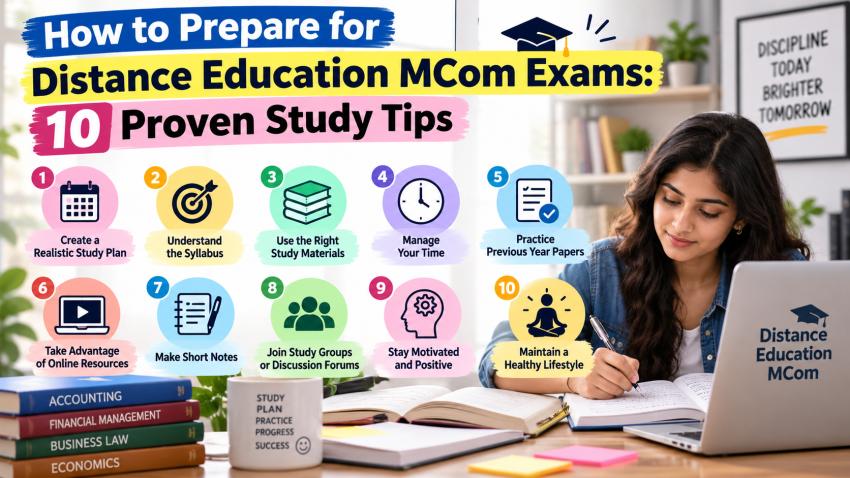
Studying for a Distance Education MCom is very different from preparing in a regular college. There are no daily classes, no teachers reminding you about deadlines, and no classmates revising beside you. You are responsible for your own schedule, your own notes, and your own motivation. That freedom is the main advantage of distance learning, but it is also the reason many students fall behind.
The good news is that a few simple habits can make a big difference. Here are ten proven study tips to help you prepare for your Distance Education MCom exams with confidence, whether you are studying alongside a full-time job or managing family responsibilities.
1. Start With the Syllabus and Exam Pattern
Before opening any book, read the syllabus and exam pattern for each paper. Find out how many units there are, how marks are divided between theory and numericals, and what types of questions are asked. Knowing that a paper has 40 percent numerical questions, for example, changes how you should spend your time.
Download the official syllabus from your university’s website and keep it handy. If you need a refresher on how papers are structured, read our guide on the MCom Distance Education syllabus and our article on the M.Com Distance Education exam pattern.
2. Build a Realistic Study Timetable
A timetable you can follow is better than a perfect one you abandon in a week. Be honest about how many hours you can give each day.
- Working professionals can often manage one to two hours on weekdays and four to five hours on weekends
- Divide the syllabus by the number of weeks left before the exam
- Assign each subject a fixed day or time slot
- Leave one day a week as a buffer for missed sessions and revision
Review your timetable every two weeks and adjust it if you are ahead or behind.
3. Study the Hardest Subjects First
Subjects like advanced accounting, financial management, statistics, and taxation need steady practice. Study them when your energy is highest, such as early morning or right after a break, rather than at the end of a tiring day. Save lighter theory subjects like business environment or organizational behaviour for times when you are less alert.
4. Use Your University’s Study Material Properly
Your study material is written for your exam, so make it your main resource. Do not ignore it in favour of random videos and guides.
- Read each unit once for understanding and a second time for note-making
- Highlight definitions, formulas, and key points
- Use the university’s e-resources, recorded lectures, and online portal
- Attend counselling or contact sessions whenever you can, since faculty often hint at important topics
Supplement with reference books or online lectures only for topics you find confusing.
5. Make Short, Smart Notes
Long notes are rarely revised. Create short notes that you can review in minutes.
- Use bullet points, flowcharts, and mind maps
- Make a formula sheet for accounting, finance, and statistics
- Write definitions in your own words
- Keep a separate page for important case laws, sections, and standards in taxation and auditing
Notes made in your own handwriting or typing help you remember better than reading alone.
6. Practise Past Question Papers
Past papers are one of the most effective tools for exam preparation. Solve at least the last three to five years of question papers for each subject.
- Time yourself to match the real exam duration
- Notice which topics appear repeatedly
- Practise writing full answers, not just reading them
- Check your answers against the study material and note your weak areas
Many universities publish previous papers on their website or student portal. If yours does not, ask your study centre.
7. Practise Numericals Every Day
For subjects like accounting, financial management, cost accounting, and statistics, reading is not enough. You need regular practice.
- Solve a few problems daily instead of many on one day
- Write each step clearly, since marks are often awarded for the method
- Redo problems you got wrong after a few days
- Learn the standard formats for statements and schedules
Even thirty minutes of daily problem solving can improve your speed and accuracy a great deal.
8. Submit Assignments Early and Use Them as Revision
Assignments are not just a requirement. They are a chance to revise each paper in depth. Many universities make submission compulsory for exam eligibility, so late or missing assignments can cost you a full session.
- Start each assignment as soon as it is released
- Write answers in your own words and avoid copying
- Keep a copy and the submission receipt
- Revisit your assignment answers before the exam, since they often cover important topics
9. Join a Study Group or Online Community
Studying alone can feel isolating, and doubts can pile up. Joining a study group, whether on WhatsApp, Telegram, or a university forum, gives you a way to ask questions, share notes, and stay motivated.
- Choose a small, active group rather than a large noisy one
- Discuss difficult topics and explain concepts to each other
- Share exam dates, notices, and deadlines
- Be careful with unverified information and always confirm updates on the official website
Teaching a concept to someone else is one of the best ways to understand it yourself.
10. Plan Your Final Revision and Exam Day
The last few weeks decide how well you convert your preparation into marks.
Two to three weeks before the exam:
- Finish the syllabus and begin full revision
- Take timed mock tests
- Focus on weak topics and formulas
One week before:
- Revise only short notes and solved problems
- Download your hall ticket and check the exam centre, date, and time
- Plan your travel and, for online exams, test your internet, camera, and device
On exam day:
- Carry your hall ticket, photo ID, and permitted stationery
- Reach the centre early
- Read the whole question paper first and plan your time
- Attempt the questions you know best first, and write neat, structured answers
- Keep a few minutes at the end to review
Bonus: Common Mistakes to Avoid
- Cramming at the last minute. The syllabus is too large for this to work
- Ignoring deadlines. Missing an exam form or assignment date can cost you a session
- Studying without a plan. Random reading wastes time
- Skipping practice. Reading numericals is not the same as solving them
- Neglecting health. Poor sleep and constant stress reduce your performance
- Comparing yourself with others. Everyone has a different pace and situation
How to Stay Motivated
Staying motivated over two years is a challenge for every distance learner.
- Set small weekly goals and reward yourself when you meet them
- Keep your reason for doing the degree visible, such as a promotion or career change
- Study in a fixed place with minimal distractions
- Take regular breaks and avoid burnout
- Talk to classmates, friends, or family about your progress
If you ever feel stuck, revisit your plan and break the next task into smaller steps.
Frequently Asked Questions
- How many hours should I study for Distance Education MCom?
It depends on your schedule and the number of papers, but many working students manage one to two hours on weekdays and longer sessions on weekends. Consistency matters more than total hours in a single day. - Is it possible to pass without attending classes?
Yes, many students pass through self-study. Counselling sessions can help but are usually optional. Regular study and practice are essential. - How can I prepare while working full time?
Use a fixed daily slot, study on weekends, make short notes for quick revision, and plan leave days around exams. - How important are past papers?
Very important. They show the pattern, difficulty level, and frequently repeated topics. - What should I do if I fall behind?
Update your timetable, prioritise high-weightage topics, and reach out to your study centre or classmates for help. Do not wait until the last week. - What if I fail a paper?
Most universities allow supplementary exams within the maximum duration. Check the rules and the exam form deadline.
Final Thoughts
Success in a Distance Education MCom comes from discipline, planning, and regular practice, not from long hours of last-minute study. Understand the syllabus and exam pattern, build a realistic timetable, practise past papers and numericals, submit assignments on time, and revise steadily. Do this consistently, and the exams become far more manageable.
If you are still deciding on a program, read our complete guide to MCom Distance Education for an overview of eligibility, fees, and career scope. If you are balancing study with a job, our article on Distance Education MCom for working professionals offers more practical advice.

