

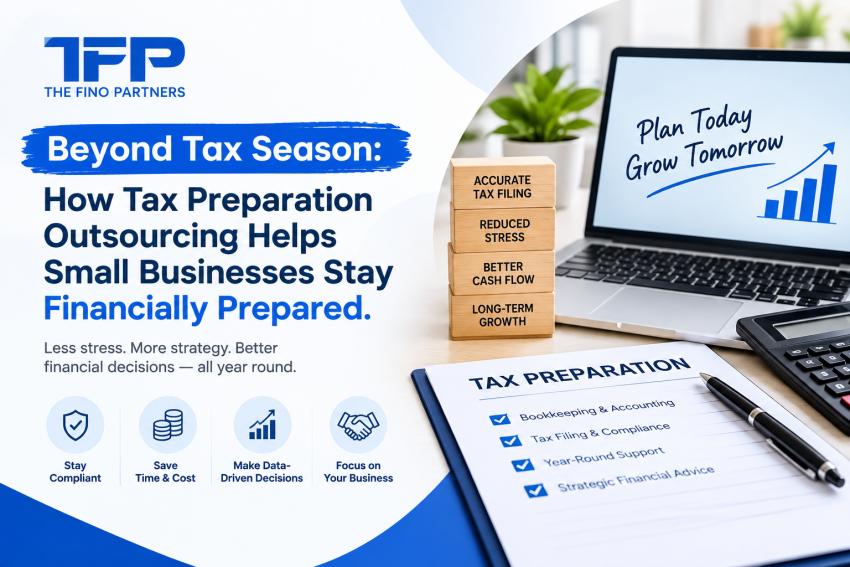
For most small business owners, dealing with taxes is an annual nightmare where receipts are pulled from drawers, bank statements are reconciled quickly, and there is a deadline to be met. Reliable tax preparation firms reverse this trend by making tax preparation a year-round activity.
Tax preparation is not just about filing your taxes. Cash flows, staffing issues, and growth plans all revolve around your tax position long before April.
This blog will provide a discussion on the benefits of tax preparation outsourcing for small businesses.
Why Small Businesses Need Tax Preparation Services Beyond the Filing Deadline
Filing a return represents only the final stage of a lengthy process. All year long, small firms make decisions which will affect their taxes, whether buying equipment or hiring contractors. In this chapter, we will analyze the reasons behind why tax preparedness needs to be ongoing, not periodic.
The Hidden Cost of Treating Taxes as a Seasonal Task
If one delays dealing with tax preparation issues, then mistakes can happen. Lost receipts, wrong classifications, and unbalanced records may result in unnecessary tax payments or deductions or an IRS inquiry. All of this could be avoided by paying attention regularly.
Another consequence of procrastination is the loss of focus on making money for the owners. Looking for documentation in March means not working with the clients.
Year-Round Obligations Many Owners Overlook
Taxes don’t wait until spring either. Businesses that employ people have to pay payroll taxes on time and distribute W-2s and 1099-NECs by the end of January. Additionally, many business owners will need to make their quarterly estimated tax payments to avoid fines.
Sales tax, state taxes, and entity-specific tax filing deadlines create another set of dates on your calendar. Failure to meet any one of them, despite filing your annual taxes without error, can result in interest and penalties.
The tax doesn’t wait for the spring either. Employers have to submit their payroll taxes, W-2s, and 1099-NECs by January 31. Furthermore, many business owners are required to pay their quarterly estimated taxes to avoid penalties.
There are yet other dates you need to consider due to sales taxes, state taxes, and entity tax filing deadlines. Missing even one, while filing annual taxes flawlessly, will cost you interests and penalties.
When It Makes Sense to Outsource Tax Preparation
There comes a stage when it is no longer viable to have everything done in-house. Should you be juggling different sources of income, hiring new people, venturing into a new state, or worrying about compliance, it is high time to think about outside assistance.
Employing a full-time tax specialist can be a costly affair for most small businesses. Having an outsourced team means having access to expertise on a more scalable level.
How to Outsource Tax Preparation Without Losing Control of Your Finances
Most owners resist giving up the control and responsibility for finances, and rightly so. This should not be about relinquishing control but about getting organized. outsource tax preparation This chapter will provide an explanation on how the process operates while maintaining ownership control.
What an Outsourced Tax Team Typically Handles
An outsourced team is able to handle all sorts of functions, from organizing financial documents, preparing federal and state returns, making estimated payments, and ensuring compliance with due dates for filings.
Some even liaise with accountants or payroll personnel to ensure that the data goes through smoothly into the preparation of tax documents. This is because such professionals deal with many clients at once.
Staying Informed Through Clear Communication
A good provider will not abandon you once they have all your documents in hand. A good provider will tell you about their assumptions, ask you questions, and give you summary documents so that you know where you stand from a tax perspective before any document is filed.
There will be scheduled follow-up and there will be secure portals where both parties will be responsible for completing certain tasks. The client signs off on the final filing.
A good provider will not desert you once they have gotten all of your paperwork. A good provider will explain to you their assumptions, ask you questions, and give you summaries of documents so that you know where you stand tax-wise prior to filing of any document.
There will be follow-ups, there will be secure portals, and both parties will be responsible for performing certain tasks. The client signs off on the final filing.
Why Tax Preparation Outsourcing Fits the Realities of Small Teams
Small firms lack the finance department as such. Employees are jacks of all trades, and there is one individual who knows about taxes. When outsourcing is done, the responsibility is shared by a group of people.
It becomes very important when a key employee quits or when an owner gets sick.
Choosing Tax Preparation Services for Small Business Owners in the USA
Not all providers will work for all businesses. tax preparation services for small business The best match is dependent on your industry, nature of your organization, and the intricacy of your financial situation. Here is what to consider.
Credentials, Experience, and Industry Familiarity
Begin by checking who is actually going to do your taxes for you. The paid preparer must have a Preparer Tax Identification Number (PTIN). Good tax preparation firms usually consist of CPAs, enrolled agents, or tax attorneys. It is important to know if your type of business structure is familiar to the preparer.
It may be either an S corporation, a Limited Liability firm, or a sole proprietorship. Different industries have different tax situations.
Data Security and Confidentiality Standards
The reason behind that is because tax file holds sensitive information like Social Security number, banking information, and payroll information, and they become easy targets for fraud. The Internal Revenue Service expects the tax professionals to create a plan that describes their information security procedure, and there are federal guidelines which ask businesses to protect sensitive information.
See if your potential service provider knows how they secure your information, and sharing it is a good sign.
First, find out who will really prepare your tax returns for you. The preparer should have the Preparer Tax Identification Number (PTIN). Good tax preparing firms will always be made up of CPAs, Enrolled Agents, or Tax Attorneys. It is necessary for you to find out whether the preparer is aware of your business entity type.
Your business could be S corporation, Limited Liability firm, or even sole proprietorship. Various industries have varying tax conditions.
Pricing Transparency and Scope of Support
Specify precisely what is covered. Does the price include advice throughout the year, estimates every quarter, and assistance in case of receiving an IRS letter? Unexpected additional costs may turn a relatively inexpensive service into an expensive one.
Check if there are tax preparation services that provide you with definite engagement conditions and a well-defined procedure for amendments and audits.
How Tax Preparation Outsourcing Supports Long-Term Growth and Compliance
The true benefit of external tax support becomes apparent over time. Apart from submitting the correct tax returns, it enhances planning, risk management, and strategic thinking on the part of leadership. The following will elaborate further on that point.
Proactive Planning That Improves Cash Flow
When a tax professional looks at your numbers throughout the year, you have the ability to make corrections before it’s too late. Knowing your estimated liability allows you to budget money, make purchases wisely, and not get a rude surprise come year end.
Planning meetings may also include topics such as retirement plans, equipment purchases, and entity type. This becomes much easier when done months ahead of year end.
Reducing Compliance Risk and Audit Stress
Organized and consistent record keeping makes every document much easier to defend. When the IRS or any other state agency has any questions, the firm that is prepared for that moment will answer them quickly and confidently.
Keeping up with new changes in legislation takes up all the time. We will make sure that our team does it for you.
Giving Owners Time to Focus on the Business
Every minute the owner spends working on tax forms is a minute lost from dealing with clients, goods, and employees. By delegating the technical process, management is free to focus on the things that only they can do.
In the case of growing firms, this becomes the difference between growth and chaos. By outsourcing your taxes, you gain resources without additional overhead.
It is important to remember that tax preparation is an ongoing process; it is not something that only happens during the holiday period. This way, all the possible mistakes can be avoided, and good decision making will be promoted. It is necessary for small enterprises to have access to professional tax preparers.
There are several main points to consider. Firstly, it is vital to understand that tax preparation is something that should go on all year round. Secondly, one should select a reliable and secure service provider. And, thirdly, one should always try to make money planning.
Are you ready to benefit from tax readiness throughout the year? Work with The Fino Partners, an outsourcing partner that is famous for equipping its clients with solutions related to finance and partnerships. Our specialists will help small businesses be in order by providing them with dependable tax services in accordance with their needs. Please contact The Fino Partners now.


