

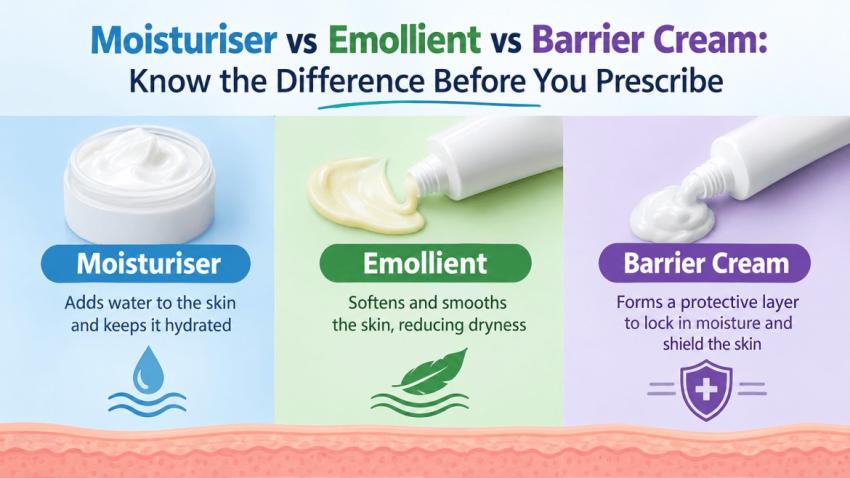
Patients ask for a “good moisturiser,” doctors write “emollient” on the slip, and the pharmacy hands over a “barrier cream.” Many people think they are all the same thing. They are not. Each one has its own job, and picking the wrong one can slow down a patient’s recovery.
This blog explains the basics in simple words, so you can choose with more confidence.
Why the Confusion Happens?
All three products go on the skin, and most of them look like a plain white cream or ointment. Their labels often use similar words like “hydrating” or “protective.” Some products even do more than one job. So it is easy to mix them up.
But the way they work is different, and so is the right time to use them.
What Is a Moisturiser?
A moisturiser is a product made to add water to the skin and help it hold that water. Most moisturisers have three types of ingredients working together.
Humectants pull water into the skin. Common ones are glycerin, urea, and hyaluronic acid. Emollients smooth and soften the surface. Occlusives form a thin layer on top to stop water from escaping.
So a moisturiser is really a mix. It brings water in, softens the skin, and locks the moisture in place. This makes it a good everyday choice for normal or mildly dry skin.
What Is an Emollient?
An emollient is an ingredient or product that softens and smooths the skin by filling the tiny gaps between skin cells. It also leaves a light coating that reduces water loss.
In clinics, the word emollient usually means a stronger, simple product used for dry and damaged skin. These come as creams, lotions, ointments, bath oils, and wash substitutes. Ointments are the thickest and work well for very dry or cracked skin. Lotions are the lightest and suit hairy or weeping areas.
Emollients are often the first step in treating eczema, psoriasis, and other dry skin problems. They are used in large amounts and many times a day.
What Is a Barrier Cream?
A barrier cream is made to protect the skin from outside harm. It sits on the surface and acts like an invisible glove. Common ingredients are zinc oxide, dimethicone, petrolatum, and sometimes other protective oils.
These creams are used when the skin faces a lot of contact with water, chemicals, urine, or friction. Think of nurses who wash their hands all day, workers who handle cleaning products, or babies in nappies. Barrier creams help stop damage before it starts.
Moisturiser vs Emollient vs Barrier Cream: The Key Differences
The simplest way to remember is this. A moisturiser adds and holds water. An emollient softens and repairs dry skin. A barrier cream shields the skin from outside irritants.
A moisturiser is mostly for daily care. An emollient is mostly for treating dry or inflamed skin. A barrier cream is mostly for prevention. They can work together, but they are not swaps for each other.
Choosing the Right One for the Patient
Start by asking what the patient needs. Is the skin simply a bit dry? A light moisturiser may be enough. Is the skin cracked, itchy, or flaring from eczema? An emollient, often an ointment or rich cream, is the better pick. Does the patient work with water or chemicals, or have skin that gets irritated by moisture? A barrier cream can protect the skin.
Also think about the site and the season. Light lotions work better in hot, humid weather and on hairy areas. Thick ointments work better in winter and on dry areas like hands, feet, and elbows.
Tips for Better Results
Even the best product fails if it is used the wrong way. Here are a few points to share with patients.
Apply emollients after a bath, while the skin is still slightly damp. Use enough product. Many patients use too little. Smooth it on in the direction of hair growth to avoid blocked follicles. Do not share tubs, and use a clean spoon or a pump to take out cream. Reapply barrier creams after every hand wash.
Patients should also know that some emollients with paraffin are flammable when soaked into clothes or bedding. Advise them to stay away from open flames and smoking.
Think About Comfort and Habit
A product that feels greasy or smells strong may be left unused in a drawer. Ask patients what they like. Some prefer a light lotion, others want a thick ointment. When the patient enjoys using the product, they use it more often, and the skin gets better results.
Final Thoughts
Understanding Moisturiser vs Emollient vs Barrier Cream is a small step that can make a big difference in daily practice. When clinicians know what each product does, they can guide patients better, avoid wasted effort, and help the skin heal faster.
Take a moment to match the product to the problem. That simple habit can turn a basic cream into a real part of the treatment plan.


