

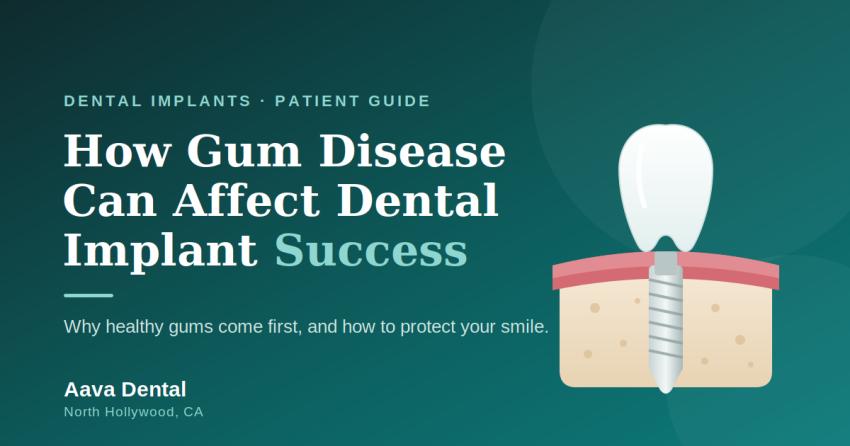
Dental implants have a strong track record. Most people who get them keep them for decades, and many keep them for life. But that success rate depends on something a lot of patients overlook, and that is the health of the gums and bone holding the implant in place. If you have gum disease, or a history of it, that foundation may not be as solid as it looks.
This is one of the most common reasons an implant fails later on, so it is worth understanding before you commit to the procedure.
What gum disease actually does to your mouth
Gum disease starts small. It usually begins as gingivitis, which is redness, puffiness, and a little bleeding when you brush. At that stage it is fully reversible with good cleaning and a professional visit.
The problem is what happens when it goes untreated. Gingivitis can move into periodontitis, a deeper infection that attacks the tissue and bone around your teeth. Once bone starts to disappear, it does not grow back on its own. You may notice gums pulling away from the teeth, bad breath that will not quit, loose teeth, or pockets forming along the gum line. These are all signs the disease has taken hold below the surface.
Why implants need healthy gums and bone
An implant is a small titanium post that sits in your jawbone and acts like an artificial tooth root. For it to work, the bone has to fuse tightly around it in a process called osseointegration. Think of it like a fence post set in concrete. If the ground around it is soft or crumbling, the post will never feel secure no matter how well it was placed.
Gum disease damages exactly the material the implant relies on. It thins out the bone and inflames the tissue, which leaves less to anchor the implant and a higher chance of infection during healing.
The risk of peri-implantitis
Here is the part many patients have never heard of. Even after an implant heals successfully, gum disease can still cause trouble down the road. There is a condition called peri-implantitis, and it works a lot like gum disease does around a natural tooth. Bacteria build up around the implant, the gum gets inflamed, and the bone supporting the implant slowly breaks down.
Left alone, peri-implantitis can loosen an implant that felt perfectly stable for years. People who have had gum disease in the past are more prone to it, which is why past infections matter even when your mouth feels fine today.
What good dentists do before placing an implant
A responsible practice will not rush you into surgery. Gum disease should be treated and brought under control first. Depending on your situation, that might mean a deep cleaning below the gum line, gum treatment, or a bone graft to rebuild what the infection took away.
"We treat the gums first and place the implant second, never the other way around," says Dr. Huzefa Saifee, the Board-Certified Periodontist at Aava Dental of North Hollywood. Putting an implant into an unhealthy mouth is setting it up to fail, and correcting the tissue and bone beforehand is what gives the implant the long life patients expect.
This is also why an exam with X-rays or a 3D scan matters so much. It shows how much healthy bone you have to work with and whether any hidden infection needs to be dealt with first.
How to protect your implant for the long haul
Getting the implant placed is only half the job. Keeping it healthy is on you, and the daily routine is not complicated:
- Brush twice a day and clean between your teeth, including around the implant.
- Keep up with regular cleanings and checkups so problems get caught early.
- Do not ignore bleeding, swelling, or tenderness near the implant.
- If you smoke, know that it raises your risk of both gum disease and implant failure, and quitting helps a lot.
The people who look after their implants the way they would a natural tooth tend to keep them the longest.
The bottom line
Gum disease and dental implants do not mix well, but that does not mean an implant is off the table if you have dealt with gum problems before. It just means the gums come first. Treat the infection, rebuild the foundation, and give the implant the healthy home it needs.
If you are thinking about implants and you have any history of gum disease, book an exam and get an honest look at where your gums stand. It is the single best step you can take to make sure your investment lasts.


