

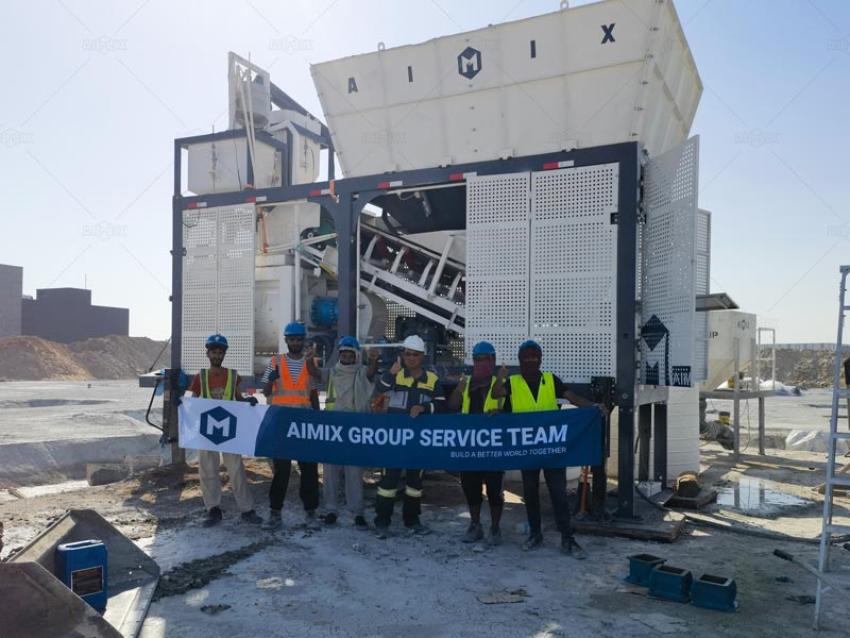
For self-built houses, concrete demand is usually distributed across several stages, including foundations, columns, beams, floor slabs, walls, and surrounding structures. A small mobile batching system allows construction teams to produce concrete when needed instead of purchasing large quantities in advance or transporting concrete over long distances.
The growing use of this equipment is therefore not simply about reducing equipment size. It reflects a broader need for flexible, economical, and controllable concrete production in rural construction.
Why Rural Housing Projects Need Flexible Concrete Production
Rural construction sites have different requirements from large urban developments. Contractors and homeowners may have to work with narrow access roads, limited electricity, uneven terrain, and relatively small daily concrete volumes.
Long-Distance Ready-Mix Delivery Can Be Difficult
Ready-mix concrete is convenient when a reliable supplier is located nearby. However, rural housing projects may be several kilometers or even much farther from commercial batching facilities.
Long transportation distances can result in:
- Higher concrete delivery costs
- Longer waiting times
- Traffic-related delays
- Reduced flexibility for small-volume orders
- Difficult coordination between concrete delivery and placement
A mobile concrete plant(planta de hormigón móvil) moves production closer to the actual construction site, reducing dependence on external delivery schedules.
Small Capacity Can Match Actual Construction Demand
One major advantage of a small mobile system is that its capacity can be better aligned with the consumption pattern of a self-built house.
Produce Concrete According to Each Construction Stage
A rural house does not necessarily require continuous concrete production throughout the day. Concrete demand may increase during foundation pouring and floor slab construction but remain relatively low during other stages.
A small mobile concrete plant can support this intermittent production model. Instead of maintaining a large permanent batching facility, the project can produce concrete according to the day's requirements.
This can help reduce material waste and avoid paying for production capacity that remains unused.
Lower Site Requirements Make Installation Easier
Rural residential construction frequently takes place on plots where space is limited. A conventional stationary batching plant may require substantial civil preparation, aggregate storage areas, and permanent infrastructure.
Simplified Deployment
A compact mobile system can reduce the amount of permanent site work required. Depending on the equipment configuration and local conditions, contractors may prepare a level and sufficiently stable operating area without constructing a large permanent concrete foundation.
Before installation, however, the site should still be evaluated for:
- Ground bearing capacity
- Surface stability and levelness
- Drainage
- Truck or loader access
- Space for aggregate and cement storage
- Safe material loading and concrete discharge
Mobility does not eliminate the need for proper site preparation.
Better Control Over Concrete Quality
When homeowners or small contractors purchase concrete from different suppliers, mix consistency may vary depending on supplier availability and transportation conditions.
Producing concrete on site provides greater control over batching.
Accurate Material Dosing Matters
A properly configured mobile concrete plant can measure aggregates, cement, water, and admixtures according to the selected mix design. This helps operators maintain more consistent proportions between batches.
For structural components such as foundations, columns, beams, and slabs, consistent concrete quality is particularly important. Operators should still follow the engineer's specified mix proportions and conduct appropriate quality checks.
Why Mobility Is Valuable for Rural Contractors
A self-built house may not be the only project handled by a small construction team. Local contractors often work on several residential projects in nearby communities.
A mobile concrete plant can potentially be relocated between worksites, allowing the same equipment to support multiple projects over its service life.
One Equipment Investment, Multiple Applications
Beyond house construction, small mobile batching equipment may support:
- Farm buildings
- Small retaining walls
- Rural roads
- Drainage structures
- Small bridges
- Agricultural infrastructure
- Residential extensions
This broader utilization can improve equipment economics for contractors who regularly undertake small construction projects.
What Should Buyers Consider Before Choosing a Plant?
The smallest available equipment is not automatically the best choice. Buyers should first estimate the project's actual concrete requirements.
Evaluate These Factors
Consider:
- Peak concrete demand per hour
- Total expected concrete volume
- Available installation space
- Aggregate supply conditions
- Power availability
- Transportation and relocation requirements
- Local maintenance and spare-parts support
- Operator experience
If production demand is extremely low, manual or mixer-based solutions may be sufficient. If several houses are being constructed simultaneously, a higher-capacity mobile system may provide better productivity.
A Practical Solution for Decentralized Housing
The growing role of small mobile batching equipment in rural housing reflects a simple construction need: concrete should be available where and when it is required.
For self-built houses, a mobile concrete plant can reduce transportation dependence, match production with construction stages, simplify deployment, and provide greater control over batching. Its value is particularly clear when projects are located far from commercial concrete suppliers or when construction teams need to move between multiple rural sites.
Ultimately, selecting the right mobile concrete plant should be based on actual concrete demand, site conditions, logistics, and future utilization. When these factors are properly evaluated, small mobile batching equipment can become a practical core tool for more efficient rural construction.